Why Chinese Bullet Train Technology Is Disrupting Global Infrastructure Projects
/ / views / Reading time 18 minWhy Chinese Bullet Train Technology Is Disrupting Global Infrastructure Projects
China’s high-speed rail (HSR) prowess has transformed the high-speed rail sector from a domain once led by Japanese and European firms into a sphere where Chinese companies are now dominant. Over the past two decades, China’s domestic network has ballooned from the first Beijing–Tianjin line in 2008 to over 45,000 km of dedicated HSR by 2025, outstripping the combined total of all other nations. This scale, coupled with rapidly advancing technology—such as the newly unveiled CR450 capable of 450 km/h test speeds—positions China as a formidable exporter of complete rail systems, from design and rolling stock to financing and operations.
Chinese exports now span Southeast Asia (Jakarta–Bandung, 350 km/h), Europe (Serbia’s Hungary–Serbia corridor), and multiple proposals in Turkey, Russia, Saudi Arabia, Brazil, and even the United States. The Belt and Road Initiative (BRI) underpins these ventures, leveraging rail exports as “infrastructure diplomacy,” fostering regional economic integration and extending China’s strategic footprint.
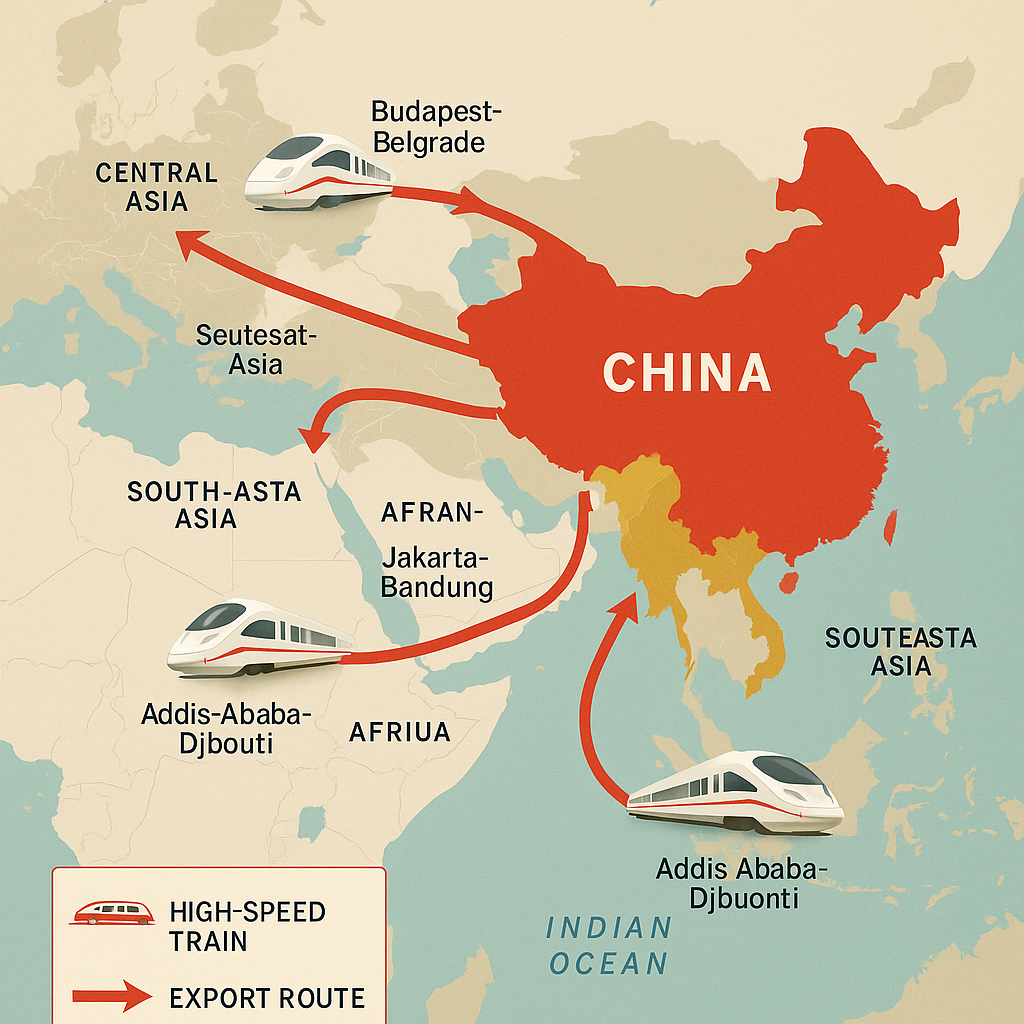
Map of global Chinese high-speed rail exports
1. Vertical Integration: A Complete Turnkey Solution
Unlike traditional suppliers who often bid on individual components or engineering services, Chinese consortia—led by China Railway Construction Corporation (CRCC) and CRRC—offer end-to-end packages:
- Track engineering and civil works
- Electrification and signaling
- Rolling stock manufacturing (e.g., Fuxing, CRH series, CR450 prototypes)
- Operations, maintenance, and staff training
This vertical integration reduces coordination risk for host governments and streamlines financing: Chinese policy banks frequently provide concessional loans covering up to 85 percent of project costs. In Indonesia’s Whoosh line (Jakarta–Bandung), the joint venture model and China EXIM Bank financing were pivotal to project execution and affordability.
2. Technological Leadership and Continuous Innovation
Chinese engineers have tackled engineering challenges—seismic zones, extreme weather, and complex terrain—at unmatched scale. Innovations include:
- Proprietary track designs and maglev experiments
- Smart scheduling and traffic management powered by AI
- Lightweight carbon-fiber composites and magnesium alloys reducing train weight by over 10 percent
- Next-gen traction and suspension for speeds up to 450 km/h
The CR450 prototypes exemplify this leadership: two variants (CR450AF and CR450BF) tested speeds over 450 km/h, featuring 22 percent lower resistance and 10 percent lighter car bodies, achieving both performance and energy efficiency gains.
3. Economies of Scale: Driving Down Costs
China’s 450 km/h bullet trains are possible because of mass production, domestic supply chains, and large-scale track construction employing automated machinery and prefabrication techniques. Unit costs for Chinese HSR equipment can be 20–30 percent lower than European counterparts, facilitating bids in price-sensitive emerging markets.
Moreover, Chinese construction firms have refined modular bridge and tunnel components—with over 20 km of coastal viaducts on the Fuzhou–Xiamen line—drastically cutting construction times and labor costs while maintaining safety and durability standards.
4. Geopolitical and Economic Leverage
HSR exports serve both economic and strategic objectives. By integrating recipient nations into a rail network built and maintained by Chinese firms, China secures long-term service contracts, promotes yuan internationalization through loan repayments, and strengthens political ties.
- Serbia: €4 billion rail and road contracts, five CRH trains purchased, enhancing China–Europe land routes and Serbia’s Balkan role.
- Laos–China corridor: Integral to the Kunming–Vientiane line, promoting regional connectivity under the BRI.
- Thailand: Bangkok–Nakhon Ratchasima phase and cross-border link to Kunming.
Such strategic projects also act as showcases, bolstering China’s standing at international forums like the Belt and Road Forum, where Chinese infrastructure achievements—like the Jakarta–Bandung line’s 46-minute, 350 km/h service—receive global media acclaim.
5. Challenges to Established Players
Japan’s Shinkansen and Europe’s Alstom, Siemens, and Bombardier face intensified competition. Chinese HSR’s bundled finance-construction-operation model, aggressive pricing, and supportive state policies (subsidies, forced technology transfers in joint ventures) have eroded these incumbents’ market share in many regions.
However, concerns remain:
- Debt sustainability: Host nations’ ability to service Chinese loans has drawn scrutiny.
- Standardization: Divergent technical norms may complicate interoperability with existing networks.
- Mercantilist practices: WTO compliance debates over forced joint ventures and domestic content requirements.
6. Implications for Global Infrastructure
China’s HSR disruption extends beyond rail: it sets new benchmarks for turnkey megaproject delivery, rapid technology iteration, and multilateral infrastructure financing. Countries evaluating large-scale transport investments increasingly view Chinese bids as credible alternatives to Western consortia, altering global infrastructure dynamics.
International stakeholders must adapt by:
- Strengthening project governance and risk assessment for debt-financed infrastructure.
- Advocating transparent procurement rules to ensure fair competition.
- Collaborating on interoperable standards to integrate diverse rail systems.
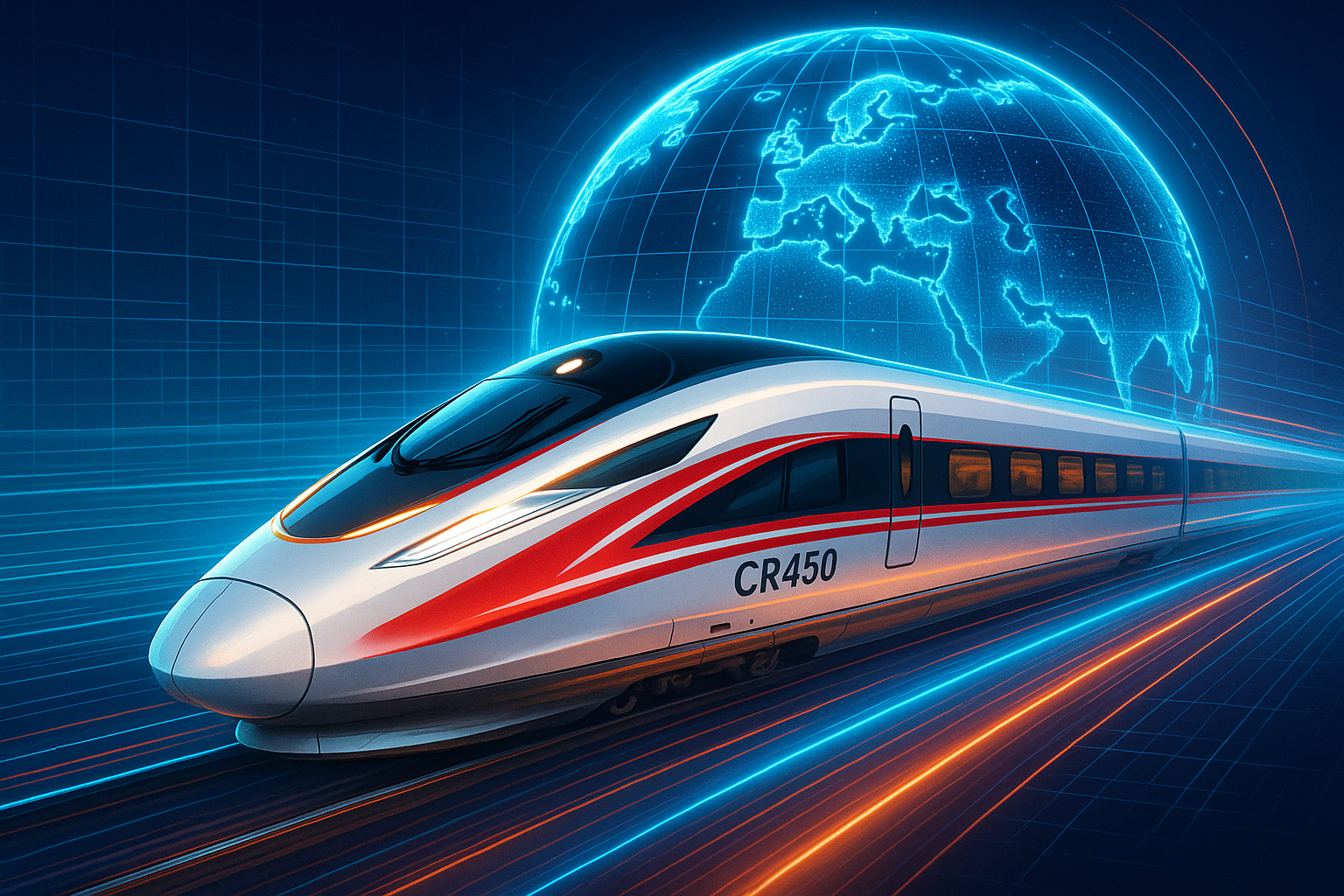
CR450 bullet train global impact
Conclusion
China’s bullet train technology—driven by vertical integration, innovation, and scale economies—is reshaping global infrastructure markets. As Chinese HSR exports proliferate across Asia, Europe, and beyond, incumbent suppliers must recalibrate their strategies. For policymakers and investors, understanding this HSR revolution is critical to navigating the evolving landscape of international transport infrastructure.